Two peptides dominate the marketing landscape of 2026: Matrixyl 3000 and Argireline. Both appear on countless serum bottles, both have catchy origin stories, and both have been positioned at various points as "the" anti-aging peptide. The honest comparison reveals they work through completely different mechanisms with very different evidence quality—and one consistently outperforms the other for the visible results most people are seeking.
This guide explains what each peptide actually does, what the controlled research shows, and why integrated formulas like AE Plumping Serum consistently lean on Matrixyl-style signaling peptides rather than Argireline-style neurotransmitter peptides. The goal isn't to declare a winner across all use cases—it's to help you understand which mechanism matches your actual concern.
What Each Peptide Actually Is
Matrixyl 3000
Matrixyl 3000 is a registered trade name for a specific peptide blend: palmitoyl tripeptide-1 + palmitoyl tetrapeptide-7. Both are signaling peptides that mimic fragments of collagen breakdown, telling fibroblasts to ramp up new collagen and elastin production.
The mechanism: 1. Topical application delivers the peptide blend to the upper epidermis 2. Peptides reach skin's fibroblasts 3. Fibroblasts receive the signal that collagen is being lost 4. Cells respond by producing more collagen and elastin 5. Over weeks, the dermis becomes structurally more supported
This is the "messenger" mechanism behind most modern peptide skincare. Read how peptides boost collagen for the deeper biology.
Argireline
Argireline is the trade name for acetyl hexapeptide-8 (formerly acetyl hexapeptide-3). It's a neurotransmitter inhibitor peptide that attempts to interfere with the SNARE protein complex—the same complex that botulinum toxin (Botox) targets, but through a much weaker and reversible mechanism.
The marketing claim: by reducing the muscle contractions that cause expression lines, Argireline reduces dynamic wrinkles. Often called "Botox in a bottle" or "topical Botox."
The mechanism: 1. Topical application delivers Argireline to skin 2. Some portion may penetrate to neuromuscular junctions 3. Theoretically interferes with neurotransmitter release 4. Theoretically reduces muscle contraction strength 5. Theoretically softens dynamic expression lines
The word "theoretically" appears multiple times because the in-vivo evidence is significantly weaker than the in-vitro mechanism suggests.
What the Evidence Actually Shows
Matrixyl 3000
Multiple controlled studies have shown: - Measurable improvement in skin thickness over 8-12 weeks - Reduction in fine line depth (modest but consistent) - Improvement in skin density and elasticity markers - Effect generally requires 8-12 weeks of consistent use to become visible - Effect compounds with longer use
The evidence quality is moderate to good—not as strong as retinoids, but solid for the peptide category.
Argireline
Studies on Argireline are mixed: - Some show modest improvement in expression line depth - Other studies show no significant difference vs. placebo - The most-cited positive studies are small and often manufacturer-funded - Independent research generally shows weaker effects than marketing implies - The claim of "Botox-like" effect is significantly inflated
The honest summary: Argireline probably does something modest in some people. It doesn't approach the effect of actual botulinum toxin injection. Marketing claims significantly outpace the controlled evidence.
The Direct Comparison
| Factor | Matrixyl 3000 | Argireline |
|---|---|---|
| :--- | :--- | :--- |
| Type | Signaling peptide | Neurotransmitter inhibitor peptide |
| Mechanism | Collagen pathway support | Muscle contraction interference |
| Target | Fibroblasts (collagen producers) | Neuromuscular junction |
| Effect on static wrinkles | Modest improvement over weeks | Limited |
| Effect on dynamic wrinkles | Indirect (via skin density) | Limited (if any) |
| Evidence quality | Moderate-good | Mixed-weak |
| Time to visible effect | 8-12 weeks | Variable, often unconvincing |
| Compounds with use | Yes | Limited |
| Comparable to procedures | No (different category) | Far weaker than Botox |
| Best use case | Foundation for anti-aging | Adjunct, not foundation |
Why Integrated Formulas Choose Matrixyl Over Argireline
If you read the INCI of well-formulated peptide serums—including AE Plumping Serum—you'll typically see palmitoyl tripeptide-1 and palmitoyl tetrapeptide-7 (the Matrixyl 3000 components) rather than Argireline. Three reasons:
1. The Evidence Is Better
Matrixyl-style signaling peptides have stronger and more consistent research support. Argireline's "Botox in a bottle" framing has been repeatedly questioned in independent studies.
2. The Mechanism Is More Useful
Signaling peptides support the underlying skin structure. Argireline tries to interfere with muscle activity—which, if it worked as marketed, would compete with botulinum toxin (which is far more effective for that purpose).
3. The Synergy Is Better
Signaling peptides pair naturally with hyaluronic acid, ceramides, and antioxidants for a comprehensive support story. Argireline doesn't have the same complementary chemistry.
Signaling peptides built into the integrated formula
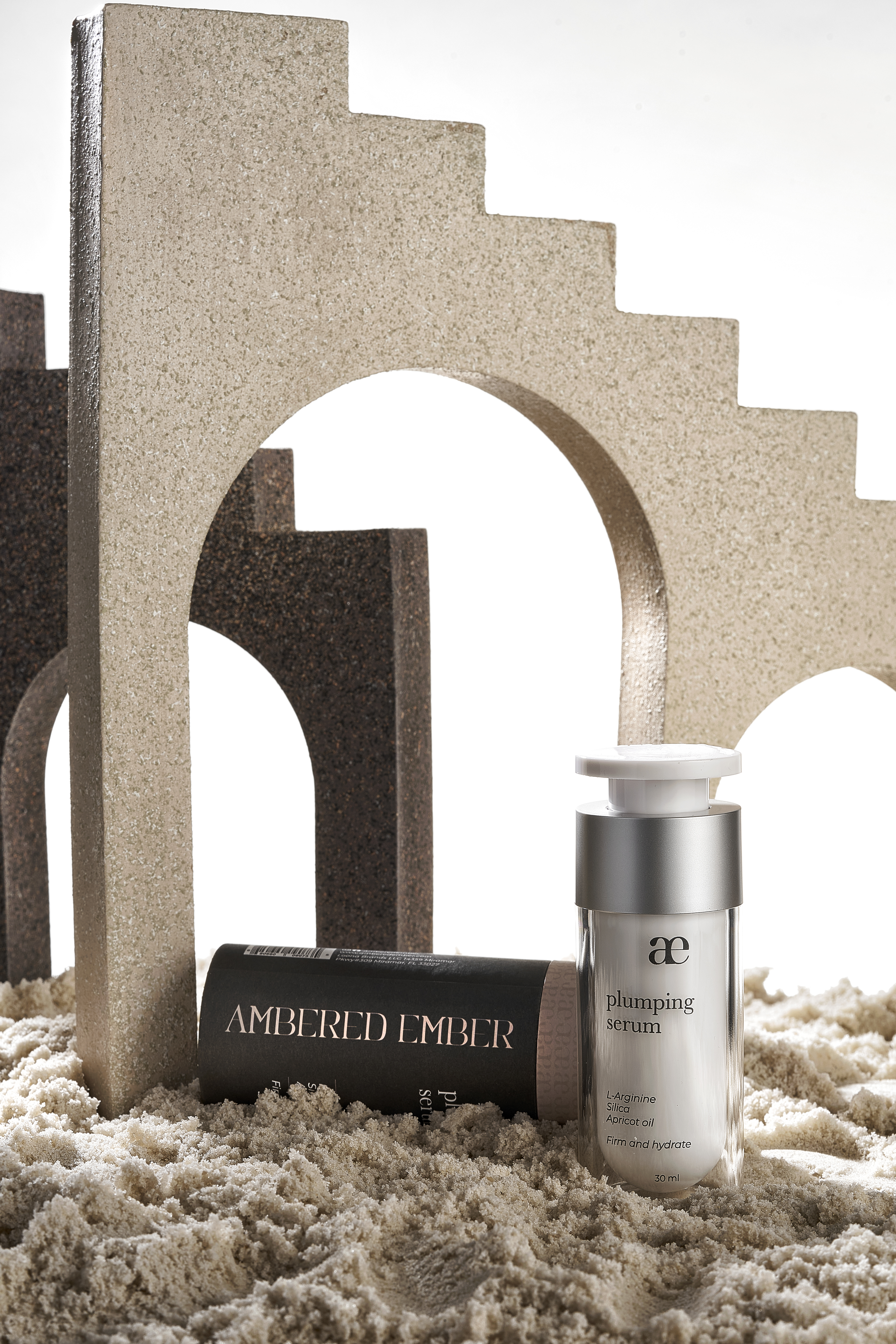
AE Plumping Serum uses palmitoyl tripeptides—the Matrixyl-style signaling chemistry—paired with multi-weight HA, ceramide NG, and niacinamide for the support that compounds.
Shop plumping serumWhen Argireline Might Make Sense
To be fair: Argireline isn't useless. It's just dramatically overhyped relative to its actual effect. Cases where it might add modest value:
What to avoid: paying premium prices for an "Argireline serum" as if it were a transformative ingredient. The math rarely justifies the price relative to a proper signaling-peptide serum.
What If You're Comparing Two Specific Serums?
When evaluating any peptide serum, the better question isn't "Matrixyl or Argireline?" — it's "What's the full active stack?"
A serum with: - Palmitoyl tripeptide-1 and tetrapeptide-7 (Matrixyl 3000) - Multi-weight hyaluronic acid - Ceramide NG - Niacinamide - Botanical antioxidants
...will outperform any single-peptide serum, regardless of whether that single peptide is Matrixyl or Argireline.
The integration matters more than the specific peptide choice within the signaling peptide category. Read how to pick a peptide serum for the full evaluation framework.
Common Questions
Is Argireline truly "Botox in a bottle"?
No. Botulinum toxin works by directly binding to neuromuscular junctions and being injected at meaningful doses. Argireline applied topically reaches the same area at much smaller effective concentration through a much weaker mechanism. The comparison is marketing.
Will Matrixyl 3000 reverse my deep wrinkles?
No—signaling peptides produce subtle, compounding firmness improvements. They soften the appearance of fine and shallow lines through density support. Deep, anatomical wrinkles need other interventions.
Can I use both Matrixyl and Argireline together?
They don't compete for the same biological pathway, so layering doesn't cause conflict. Whether the Argireline adds anything meaningful is the open question.
How long until I see results from a Matrixyl-containing serum?
Hydration improvements within 1-2 weeks (from the surrounding HA). Peptide-driven structural support over 8-12 weeks.
What about Matrixyl Synthe'6 or other Matrixyl variants?
Different specific peptide blends from the same family. Matrixyl 3000 is the most-studied. Newer variants have less evidence behind them despite frequently being marketed as "next-generation."
The Verdict
If you're choosing between a Matrixyl-containing serum and an Argireline-containing serum, the evidence overwhelmingly supports Matrixyl-style signaling peptides for visible firmness and texture support. Argireline's "topical Botox" claim is one of the more inflated marketing positions in modern skincare.
For most people, the best approach isn't choosing a single-peptide serum at all—it's choosing an integrated formula that uses signaling peptides alongside hydration, barrier reinforcement, and antioxidants. AE Plumping Serum is built on exactly this logic: palmitoyl tripeptides for collagen-adjacent signaling, paired with multi-weight HA, ceramide NG, niacinamide, and botanical antioxidants.
Try the integrated signaling-peptide approach with AE Plumping Serum—and skip the Argireline marketing trap.